
VO2max for Health
I don't know about you, but when I hear the term VO2max, I think about elite competition performance. I think about an intensive test that spits out a number only useful to professional or top level endurance athletes.
Why would the rest of us need to care what our VO2max is? Well, VO2max is something we should all be interested in. We should want to find out what ours is, and be determined to increase it, maintain it, or at the very least slow down its inevitable decline.
Why? As longevity expert Peter Attia explains, VO2max is one of the strongest predictors of lifespan we have, more closely linked to reduced mortality risk than almost any other measure available to us (Attia, 2023). A large cohort study of over 122,000 adults undergoing treadmill testing found cardiorespiratory fitness was inversely associated with long term mortality, with no upper limit to the benefit. Even people already in the "high" fitness bracket had a meaningfully higher risk of dying during follow up than those in the "elite" bracket (Mandsager et al., 2018).
What is VO2max?
VO2max is the size of your engine. It is how quickly you can take oxygen into your lungs from the air around you, get that oxygen into your blood to be pumped around the body to your muscles, and then have those muscles actually use it. The V stands for volume, O2 is oxygen, and max is the most you can do. So VO2max is the maximum volume of oxygen your body can utilise. The more oxygen your body can consume during high intensity exercise, the higher your VO2max. You might have a huge lung capacity, but if your body is inefficient at using the oxygen you breathe in, your VO2max still won't be that high.
Your weight plays a factor too. VO2max is measured in millilitres of oxygen per kilogram of bodyweight per minute. So to increase your score, you either need to A) improve your body's ability to utilise oxygen through training, or B) reduce your weight. This second option needs care, because the last thing any of us want as we get older is to lose muscle mass in the process.
Why should you care if you're not an athlete?
Our bodies need oxygen for everything we do. If our blood stops transporting oxygen around the body, we can't do anything, we can't even think clearly, let alone move.
A good everyday example is climbing a flight of stairs, which has a VO2 cost of around 16ml of oxygen per kilogram of bodyweight. Most of us wouldn't think twice about climbing a flight of stairs, but by the time we reach 70 and beyond, if we only have an average VO2max for our age and gender, that same flight of stairs can demand 60 to 80% of our total aerobic capacity. Here in New Zealand there aren't many flights of stairs to contend with day to day, but the same demand shows up in things like getting in and out of the boat, climbing up into the caravan, stepping up onto a bus, or getting up a ladder to clean the gutters.
If, at 70 plus, your VO2max sits in the elite band instead, that same flight of stairs uses less than 45% of your aerobic capacity. That's a huge difference. Land in that elite bracket in your 70s and you'll be carrying the average VO2max of a 30 year old. It sounds almost impossible, but with the right training, most people are capable of getting there. And it isn't really about the stairs. It's about being able to pick up the grandkids, play with them, go on walks or bike rides later in life, and get through normal daily activities without them feeling like hard work.
The decline, and the good news
VO2max doesn't decline at a fixed rate through life. Longitudinal data from the Baltimore Longitudinal Study of Aging shows the drop is gradual through our 20s and 30s, in the order of 3 to 6% per decade, but it accelerates significantly from there, exceeding 20% per decade once we're past 70 (Fleg et al., 2005). The higher your VO2max is now, the higher it is likely to be as you age, and the flatter that later curve is likely to be. The best time to start building a high VO2max was years ago. The next best time is now.
The encouraging part is that it is never too late to start. A meta-analysis of 41 controlled trials in over 2,100 older adults found aerobic training produced an average 16.3% improvement in VO2max, with the biggest gains coming from programmes running longer than 20 weeks (Huang et al., 2005). Even a previously untrained, deconditioned person starting a simple zone 2 aerobic programme, one that slowly builds volume and frequency, will see their VO2max climb.
Then there's the case of French cyclist Robert Marchand. In 2012, at 101 years old, he rode 24.25km in one hour. Two years later, at 103, he rode 26.92km in one hour, having followed a dedicated training plan developed by researchers at the University of Evry Val d'Essonne. Over that period his VO2max rose from 31 to 35, a 13% increase (Billat et al., 2017). Remarkable for someone of that age, and for someone who kept riding until 108 and lived to 109. It's a good demonstration of what the current thinking on longevity is really about: live a longer, healthier, more active life, or as we say here at Tristar Performance, Live Better. Age Well.
Peter Attia also makes the point that there is nobody who can't get into the top 25% of their age and gender category with the right amount of training (Attia, 2023). So whoever you are, wherever you are in life, if you can train, you can get yourself into that top quarter.
How do I improve my VO2max?
Here at Tristar Performance, we're not doctors or health practitioners, so it's important you get your heart health checked before starting any training programme that involves high intensity work.
That said, the first job is building a good base aerobic level before pushing hard into VO2max specific training. The good news is that while you're developing that base, you're also developing your VO2max at the same time. Even for a deconditioned or untrained person, starting a low intensity, zone 2 aerobic programme that slowly adds volume and frequency will increase VO2max on its own. But to really start pushing the number up, you need to introduce more intense efforts. Once a week, warm up for 15 to 30 minutes, then perform 4 minute intervals at around 9 out of 10 perceived effort, followed by 4 minutes of recovery. Start with 3 of these and build up to 6 over time. If you've had a VO2max or lactate test done, you'll have an actual pace or heart rate to aim for during these efforts.
Strength is a very close second to VO2max (a topic for a later blog), because these are two metrics that can't be faked and can't be crammed for. If your scores are low, your scores are low. Genetics play a role in VO2max, just as they do in strength and everything else, but there is nothing that can't be improved through training. The real benefit of exercise comes from the accumulation of intensity, duration and specificity of training over time, and VO2max is one of the clearest single numbers we have for measuring that.
For the nerds among us, VO2max can be thought of as the integral of your work rate over time between two points, a big area under a small curve. The same logic applies to strength, and to grip strength specifically, which correlates so closely with overall strength that they're almost the same measurement. You can't take someone who isn't strong and make them strong overnight, and the same is true here. A real read on your longevity prowess is going to come from metrics that can't be changed quickly or faked on the day.
Get a baseline test done. It gives you a benchmark, and it shows you where you sit relative to others your age and gender.
How is VO2max tested?
Here at Tristar Performance, we put you through a graded exercise test using the VO2 Master, on either the rowing machine, treadmill or spin bike. After a short warm up, we gradually increase either the speed or the incline until you reach maximal exertion. We move through the stages quickly so you hit the point of aerobic exhaustion before muscular fatigue sets in and disrupts the test.
You don't need to be a runner to do this. On the treadmill we can run a modified Bruce protocol, which starts at a walking pace on a gentle incline and steps up gradually, so someone who has never run in their life can still get a genuine maximal result. And a true maximal test isn't the only option. The VO2 Master also allows for submaximal protocols, where we estimate your VO2max from your response to a few lower intensity stages rather than pushing you all the way to exhaustion. This is a good fit for anyone who isn't ready for a maximal effort test, whether that's for health reasons, confidence, or simply preference, and it still gives a genuinely useful number to work from.
If you're not a competitive athlete, testing once or twice a year is a good way to track where you're currently at.
What's a good VO2max score for my age?
The table below shows VO2max in ml/kg/min by age and gender, split into five performance bands: low (bottom 25%), below average, above average, high, and elite (roughly the top 5%).
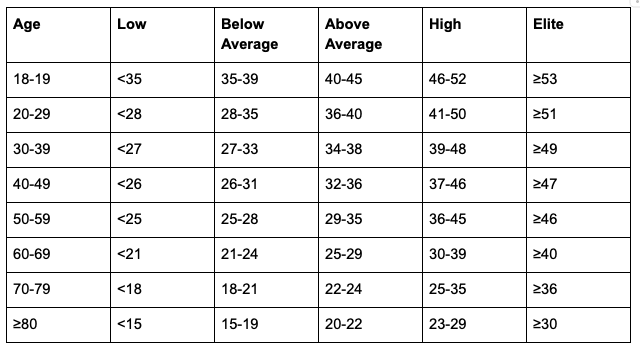
Women
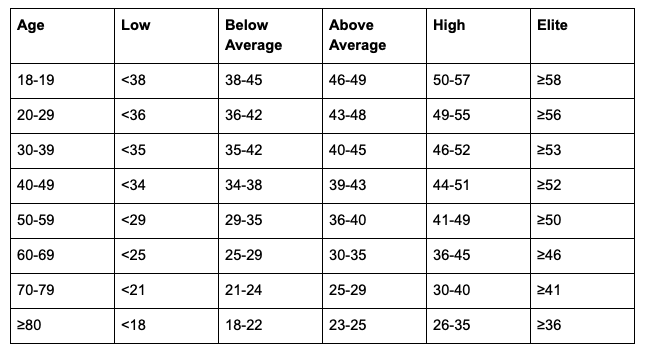
Men
(adapted from Mandsager et al., 2018)
References
Attia, P. (2023). Outlive: The science and art of longevity. Harmony Books.
Billat, V., Dhonneur, G., Mille-Hamard, L., Le Moyec, L., Momken, I., Launay, T., Koralsztein, J. P., & Besse, S. (2017). Case studies in physiology: Maximal oxygen consumption and performance in a centenarian cyclist. Journal of Applied Physiology, 122(3), 430–434. https://doi.org/10.1152/japplphysiol.00569.2016
Fleg, J. L., Morrell, C. H., Bos, A. G., Brant, L. J., Talbot, L. A., Wright, J. G., & Lakatta, E. G. (2005). Accelerated longitudinal decline of aerobic capacity in healthy older adults. Circulation, 112(5), 674–682. https://doi.org/10.1161/CIRCULATIONAHA.105.545459
Huang, G., Gibson, C. A., Tran, Z. V., & Osness, W. H. (2005). Controlled endurance exercise training and VO2max changes in older adults: A meta-analysis. Preventive Cardiology, 8(4), 217–225. https://doi.org/10.1111/j.0197-3118.2005.04324.x
Mandsager, K., Harb, S., Cremer, P., Phelan, D., Nissen, S. E., & Jaber, W. (2018). Association of cardiorespiratory fitness with long-term mortality among adults undergoing exercise treadmill testing. JAMA Network Open, 1(6), e183605. https://doi.org/10.1001/jamanetworkopen.2018.3605
